
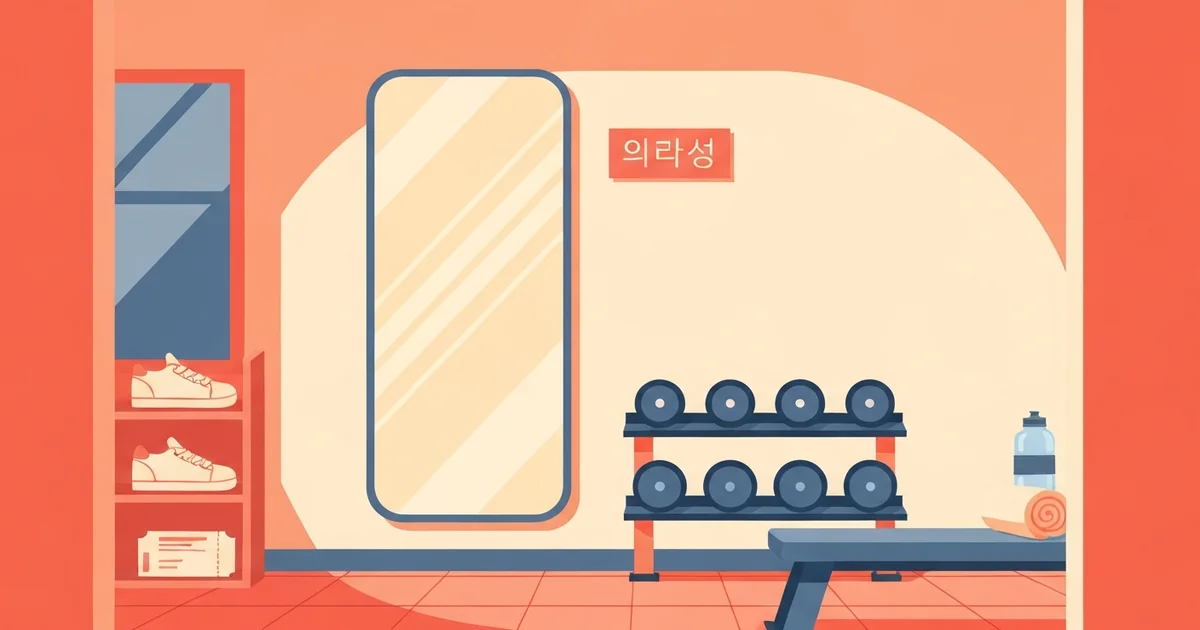
Walk into almost any Seoul apartment complex, and you'll find 헬스장 on the lobby floor directory. Sometimes basement level. Sometimes rooftop. The word is everywhere in South Korea, and it's the short answer to 'gym in Korean': 헬스 (helsu, from English 'health') plus 장 (jang, a suffix meaning 'place'). Put them together and you get a health place. Simple enough on the surface. There's a lot underneath.
헬스장, 헬스클럽, 운동장: which word fits?
The standard word for gym is 헬스장. You'll find it on signs, on Kakao Map search results, and in the names of gym chains across the country. The Gym word page has audio, but here's what the word itself tells you: 헬스 is the borrowed form of 'health,' absorbed into everyday Korean vocabulary through the late 20th century. 장 (場) is a suffix that marks physical spaces. You've already seen it if you've studied any Korean: 시장 (sijang, market), 공장 (gongjang, factory), Swimming Pool is 수영장. Same character, different activity in front of it.
헬스클럽 (helseuklelleob) is the second term worth knowing. It's the 'health club' version, slightly more upscale in feel. Big chains and hotel-adjacent facilities in Gangnam or Yeouido tend to go by 헬스클럽. The neighborhood spot on the second floor of a local commercial building almost always calls itself 헬스장. Neither is wrong. The difference is roughly 'gym' versus 'fitness club' in English: same activity, different implied price point.
운동장 is a different word entirely. Don't use it when you're looking for a treadmill. 운동 (undong) means exercise or movement, and 운동장 is an outdoor sports ground or school track, not an indoor weight room. Learn Exercise separately as a standalone word. You'll use 운동 constantly in Korean fitness contexts, including in phrases like '운동해요' (I exercise) or '운동 좋아해요?' (Do you like working out?)
What a Seoul 헬스장 actually looks like
Korean gyms are, on average, more mirror-dense than what you'd find in Australia or North America. Wall-to-wall mirrors are standard even in small neighborhood 헬스장. They serve two functions: letting people check form during lifts, and making a compact layout feel larger. Most neighborhood 헬스장 in Seoul occupy somewhere between 80 and 150 square meters on a non-ground floor of a commercial building, with weights on one side and cardio machines on the other.
The concept of 몸짱 (momjjang) explains a lot about Korean gym culture. 몸 (mom) means body. 짱 (jjang) is slang for 'top-tier' or 'the best at something.' A 몸짱 is someone with an exceptional physique, and the aspiration shapes Korean fitness marketing in ways that aren't subtle. Every supplement display, every elevator ad for a gym, every Instagram fitness post you'll see from Korean accounts is calibrated around it.
K-pop adds its own layer. Groups like LE SSERAFIM, whose 2022 single ANTIFRAGILE drew its concept from Nassim Taleb's book of the same name, emerge from Idol Trainee System where physical conditioning is as fundamental as vocals and choreography. The ordinary 헬스장 visitor isn't training on that schedule, but the aesthetic standard those groups set is part of what 몸짱 means to Korean gym culture. The connection runs in both directions: the gym mirrors the stage, and the stage shapes what people want in the mirror.
Practically speaking, you'll notice most Korean gyms include separate locker rooms for each gender (labeled 남 for male, 여 for female), and a front desk where you pay for membership in monthly or multi-month installments. Monthly rates in 2024 Seoul ranged from roughly 50,000 to 120,000 won depending on the facility and whether a trainer is bundled in. Many gyms also offer a 사우나 (sauna) in the locker room area, which is often included with your membership.
Talking to staff and trainers in Korean
Most 헬스장 in Seoul operate on a 상담 (sangdam, consultation) model at the entrance. You don't just swipe a card on your first visit. You talk to someone, pick a membership tier, and often get a free PT session included to introduce you to personal training. That first conversation goes faster with a few phrases in your pocket. The Personal Trainer word page covers the vocabulary with audio.
The phrases that actually come up at sign-up are straightforward. '등록하고 싶어요 (deungnok hago sipeoyo)' means 'I'd like to sign up.' '한 달에 얼마예요? (han dare eolmayeyo?)' is 'How much per month?' For personal training, '개인 트레이닝 있어요? (gaein teuraining isseoyo?)' gets you the answer. Three phrases and patience will carry you through most gym sign-ups even if your Korean is still basic.
Once you're actually working out, Exercise and Muscle are two words a trainer will use constantly during sessions. 근육 (geunyuk, muscle) comes up a lot: '이 근육이 약해요' (i geunyuki yakaeyo, 'this muscle is weak') is something Korean trainers say with cheerful honesty. '좀 더 천천히 (jom deo cheoncheonhi)' means 'a little slower,' which is useful for pace corrections during any exercise.
Essential words for your gym bag
- 헬스장 (helseujang): the standard word for gym. See Gym for audio and an example sentence.
- 헬스클럽 (helseuklelleob): health club, slightly more upscale. Same meaning, different register.
- 운동 (undong): exercise or workout. The verb is 운동하다 (undong hada). See Exercise.
- 트레이너 (teureineo): trainer, borrowed from English. 개인 트레이너 (gaein teureineo) is personal trainer. See Personal Trainer.
- 근육 (geunyuk): muscle. You'll hear this constantly from trainers and gym partners. See Muscle.
- 스트레칭 (seuteurecheong): stretching, from English. Korean trainers emphasize it at the start and end of every session.
- 몸짱 (momjjang): someone with an exceptional physique. Common in Korean fitness culture and social media.
- 등록 (deungnok): registration. 등록하다 is the verb 'to register,' used when signing up for a membership.
- PT (피티): short for Personal Training. '피티 받아요' means 'I'm doing personal training sessions.'
Common questions
Q: What's the difference between 헬스장 and 헬스클럽 in Korean?
Both mean gym or fitness facility, but they sit at different points on an implied quality scale. 헬스장 is the everyday word, the one on your apartment building directory, and it's correct in any context. 헬스클럽 skews toward larger, more premium spaces, which is why hotel gyms and big chain facilities in Gangnam or Yeouido tend to use it. In practice, most Koreans don't overthink the distinction. You can say 헬스장 anywhere without sounding wrong. The difference is roughly 'gym' versus 'fitness center' in English. Both are understood. One just signals a higher price point.
Q: How do I ask about gym membership prices in Korean?
The most useful phrase is '한 달에 얼마예요? (han dare eolmayeyo?),' which means 'How much is it per month?' You can also ask '3개월 권도 있어요? (sam gaewol gwondo isseoyo?)' for 'Do you have a 3-month pass?' Korean gyms frequently discount multi-month memberships, so it's worth asking. If the conversation gets complicated, most front-desk staff are happy to write numbers on paper or show you a laminated price list. See Wellness culture for related vocabulary in this space.
Q: Is there Korean gym etiquette I should know before going?
Yes, and most of it centers on shoes and towels. Most Korean gyms ask you to change into indoor-only sneakers or at minimum bring clean ones that haven't been worn on the street that day. Your Gym wear matters too: dedicated workout clothes rather than casual street clothes is the unwritten standard. Towels are usually available to rent or buy at the front desk. The locker room 사우나 (sauna), where one exists, has its own unspoken entry rules including showering before you enter. You don't need perfect Korean to figure these out. Watching what regulars do on your first visit will teach you more than any vocabulary list.
Practice your Korean at the 헬스장
A Korean gym might be the most low-stakes place to use vocabulary in real life. People aren't there for long conversations. They're there to work out. A few phrases go a long way: '실례합니다' (sillyehamnida, excuse me), '이거 써도 돼요?' (igeo sseodo dwaeyo?, can I use this?), and '얼마나 남았어요?' (eolmana namatsseoyo?, how long do you have left?) will handle most gym-floor interaction. Koko AI gives you a free space to practice these conversations before you set foot in a real 헬스장 in Seoul or Busan. One word at a time.
