
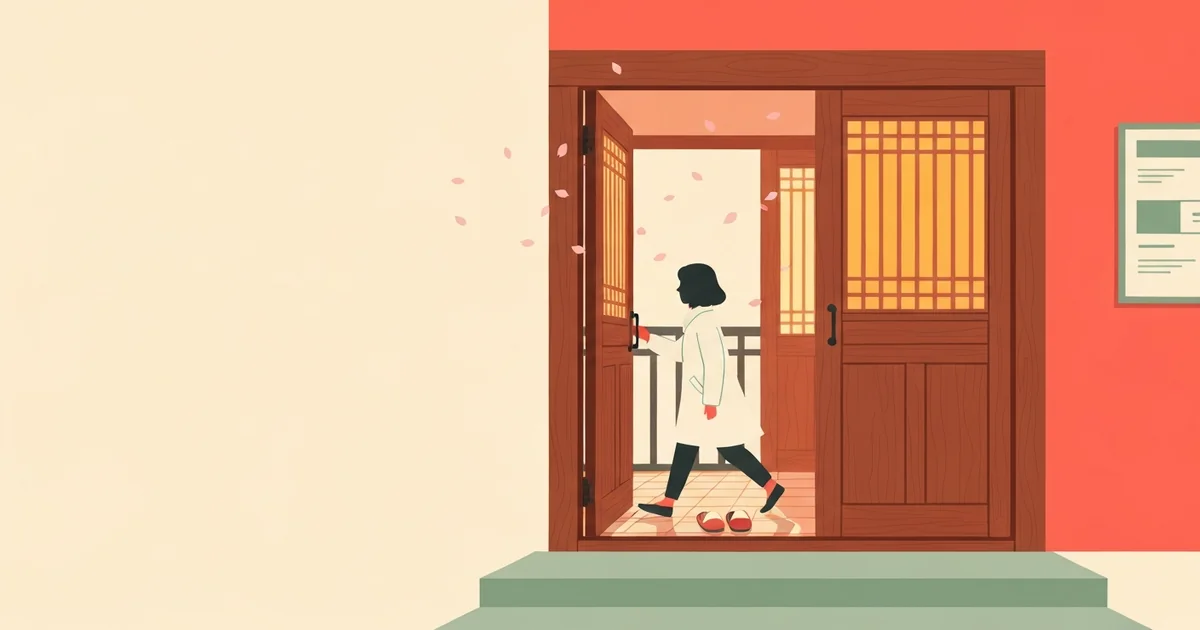
German uses one word no matter who's walking out the door. Korean tracks the movement. If you're leaving, you say 안녕히 계세요 (annyeonghi gyeseyo). If you're staying while someone else departs, you say 안녕히 가세요 (annyeonghi gaseyo). One rule, two phrases, and suddenly the goodbyes you've heard in every K-drama start making a different kind of sense.
One farewell or two?
The formal Korean goodbye has a direction built into it. Both phrases share the same root: 안녕히 (annyeonghi), meaning peacefully or safely. What comes after depends on where you're standing when the moment arrives. Korean doesn't collapse both sides of a farewell into a single word. It names which body is moving and which one is staying put.
That distinction doesn't exist in German. Auf Wiedersehen works equally for the person who picks up their bag and heads for the exit and for the person who stays at the table watching them go. Korean splits the function. It's a design choice, and once you've heard both phrases used correctly in a real Korean conversation, the underlying logic feels not just clear but completely inevitable. The goodbye in Korean vocabulary page has audio for both if you want to hear the 가세요 and 계세요 difference before you try them out loud yourself.
When you're the one leaving
You've finished dinner. Your host has cleared the table. You're at the door, shoes on. This is when you say 안녕히 계세요 (annyeonghi gyeseyo).
계세요 comes from 있다 (isseuda), the verb for being or staying, with the formal honorific ending 세요 attached. Put together, 안녕히 계세요 means something close to 'please remain in peace.' You're not just closing the encounter. You're actively wishing continued wellbeing on the people who stay behind after you go. A host at the end of a dinner deserves it. A teacher after class deserves it. A shopkeeper in Myeongdong who just finished ringing up your purchase deserves it too. The honorifics in Korean system shapes exactly when the 세요 ending fits versus simpler verb endings, but for most adults you meet for the first time, 안녕히 계세요 is the safe, respectful choice.
Seeing someone off from your doorstep
Flip the situation. Your guest is heading home. You're the one standing at the door while they pull on their coat. Say 안녕히 가세요 (annyeonghi gaseyo).
가세요 comes from 가다 (gada), the verb 'to go,' with the same honorific 세요 ending. The phrase means go in peace, or go safely. You'll hear it everywhere in Seoul. Walk out of a convenience store in Gangnam and the staff will call it toward your back without looking up from the register. A cafe barista in Hongdae says it after handing over your drink. It carries a warmth that 'goodbye' in English doesn't quite reach, partly because you're wishing the person safe passage through whatever comes next rather than simply marking the end of an encounter.
Casual goodbyes for close friends
Between close friends, 가세요 and 계세요 don't fit. The honorific 세요 creates formality where none belongs. Drop the ending entirely.
안녕 (annyeong) does double duty. If you've already picked up how to say hello in Korean, you already have the casual goodbye. Same word, different direction. Use it arriving. Use it leaving. It's that simple.
잘 가 (jal ga) adds a directional note: go well. Say it to a close friend, or to anyone you'd address in the casual speech register. 또 봐 (ddo bwa) means see you again, short and forward-looking. It's the casual parting you'll hear most often between peers in Seoul. 나중에 봐 (najunge bwa) means see you later, with a sense of a specific next time built in. 조심히 가세요 (josimhi gaseyo) is worth adding once you're comfortable with the basics: it means go carefully, and it's what you reach for when someone faces a long trip home, a rainy evening, or a late-night commute across the city.
What the direction says about Korean social awareness
The split isn't just grammar. It's attention.
The 2015 tvN drama Reply 1988, set in Seoul's real Ssangmun-dong neighborhood, captures this instinct more vividly than any textbook could. Neighbors in those narrow lanes step outside to see each other off at the alley entrance, and sometimes walk together to the corner of the block before one of them finally turns back. The person leaving says 안녕히 계세요. The people watching from the gate say 안녕히 가세요. Both directions, same moment, same lane. What you're doing in that exchange isn't just following grammar. You're naming who is in motion and who is standing still, and Korean encodes that awareness as a form of courtesy in a way that German's symmetrical Auf Wiedersehen simply doesn't need to.
All the phrases at a glance
- 안녕히 계세요 (annyeonghi gyeseyo): said by the person leaving, means stay in peace
- 안녕히 가세요 (annyeonghi gaseyo): said by the person staying, means go in peace
- 안녕 (annyeong): casual goodbye for close friends and peers, same word as casual hello
- 잘 가 (jal ga): go well, casual send-off for someone you'd address informally
- 또 봐 (ddo bwa): see you again, most common casual parting between Seoul peers
- 나중에 봐 (najunge bwa): see you later, with the sense of a next meeting already in mind
- 조심히 가세요 (josimhi gaseyo): go carefully, for long trips, bad weather, or late-night travel
Common questions
Q: What's the Korean phrase closest to Auf Wiedersehen?
The closest formal match depends on where you're standing. If you're leaving, 안녕히 계세요 (annyeonghi gyeseyo) is the phrase. If you're staying while the other person walks away, 안녕히 가세요 (annyeonghi gaseyo) is the one. Both share the root 안녕히 (peacefully), and both work for any polite adult interaction regardless of relative age or gender. The goodbye in Korean page breaks down the pronunciation for both forms, with audio so you can practice the 가 versus 계 distinction before your first real Korean farewell.
Q: Can I just use 안녕히 가세요 for everyone to keep it simple?
You can, and most Korean speakers will understand you without any confusion. Using the wrong directional form isn't rude, especially for a learner. The usual response is a patient correction or a natural reply that models the right form back to you so you can register the adjustment without embarrassment. The rule itself isn't hard: 가세요 when the other person is leaving, 계세요 when you're the one heading out. Say each phrase a few times in real situations and it becomes automatic. Korean teachers in Seoul often describe this as the one distinction that can't be unseen once you've grasped it.
Q: How do you say 'see you later' in Korean?
나중에 봐 (najunge bwa) is the casual form: 나중에 means later, and 봐 is the informal verb to see. Use it with friends, classmates, or anyone you'd address without the honorific ending. For a polite context, 나중에 봬요 (najunge bwaeyo) softens the farewell with a light honorific marker. 또 봐 (see you again) or 내일 봐 (see you tomorrow) both work well when you want to signal a specific next time. And if a visit is wrapping up, pairing your farewell with knowing how to say thank you in Korean rounds out the send-off in a way that feels genuinely warm rather than abrupt.
Start with the direction
You don't need every phrase memorized before your first Korean goodbye. Pick 안녕히 가세요 and 안녕히 계세요. Say 가세요 when the other person is the one moving toward the door. Say 계세요 when you're the one heading out. That pair handles formal farewells entirely. Add 잘 가 and 또 봐 for close friends once those two feel natural. Koko's word pages include audio for each phrase so you can check your pronunciation at any point. The direction is the key, and now you have it.
