
Every Chuseok, the highways from Seoul to Busan turn into parking lots. News anchors spend the week repeating 귀향 (gwihyang), which means homeward journey. The destination, though, isn't 집. It's 고향. Ask a Korean speaker for a single translation of 'home' and you'll get at least three candidates back, each doing something different. Picking the wrong one doesn't make you wrong, exactly. It makes you sound like someone who just arrived.
Three words, three different kinds of home
Korean distributes what English puts into one word across at least three separate nouns. Which one you reach for depends entirely on what kind of home you mean. 집 (jip) is the physical one. The building. The address you give a taxi driver. You say 집에 가다 (jib-e gada) when you're heading back to your apartment after a long day, and 집에 있어요 when someone calls and you're already sitting on the couch. Home in Korean at its most concrete is this word: where you sleep, not necessarily where you're from. 고향 (gohyang) is where you're from. It comes from 고(故), meaning 'old' or 'past,' and 향(鄕), meaning 'place' or 'village.' Usually translated as hometown, it lands closer to 'the place that shaped you.' Most Korean adults who moved to Seoul for school or work carry one. The question 고향이 어디예요? ('where are you from?') arrives early in most new friendships, and the expected answer isn't a neighborhood. It's a city, often an hour or more away. 가정 (gajeong) is the household, the family unit under one roof. It's formal. You'll find it on government forms, in news articles about family welfare policy, and in set phrases like 건강한 가정 ('a healthy family home'). You wouldn't use it to tell a friend you're heading back for the night.
고향 and the weight of being from somewhere
I've been sitting with this word for most of my life. My grandmother never moved to Seoul. She talked about her 고향 the way people talk about someone they love and haven't seen in too long. There's a concept in Korean that explains why: 정 (jeong), the deep emotional attachment that forms between people and places over years. You develop 정 with a neighborhood, with a particular kitchen, with the exact view from a particular window. Leaving any of it is complicated, even when you wanted to leave. 응답하라 1988 (Reply 1988, 2015, tvN) is set in the real Ssangmun-dong neighborhood of northern Seoul. Every character has a 고향, even the ones whose childhood home is only a few subway stops away. The whole series turns on one quiet question: what do you owe the place that raised you? When the characters finally scatter to universities and new lives, the loss is as real as any they've named out loud. That shift, from 집 to 고향, is the drama underneath the drama. When two Koreans meet for the first time, 고향이 어디예요? often comes up in the first five minutes, right after names and ages. The answer positions you inside Korea's internal geography: coastal or inland, Gyeongsang or Jeolla or Gangwon, Seoul-born or not. Regional identity carries real social weight here. Accents are recognizable. Local foods differ. The word 고향 opens all of that. Chuseok in autumn and Seollal in January are when 고향 becomes a national event. Millions of Koreans travel from Seoul to cities they haven't lived in for years. The journeys are famously slow (road trips that normally take two hours can stretch to eight). People make them anyway. That stubbornness tells you something about the weight of the word.
Everyday 집 in real Korean conversation
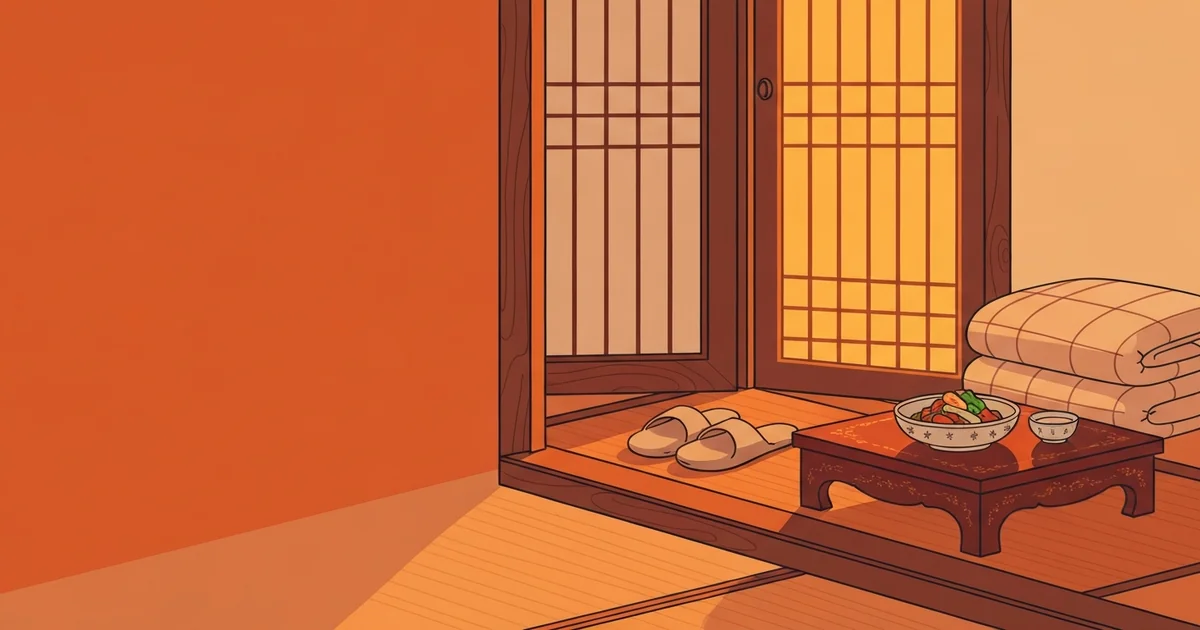
Most practical questions about 'home in Korean' are really questions about 집. Here's where it shows up most often. You'll hear 집에 가자 ('let's go home') after any late night in Hongdae. You'll see 집이 어디예요? ('where do you live?') on every beginner worksheet. One small thing that surprises many learners: Koreans say 우리 집 (uri jip, literally 'our home') where English speakers say 'my home,' even when they live alone. The 우리 isn't a grammatical error or false modesty. It's a habit that codes the home as shared rather than possessed, the way older houses pass through generations without ever really belonging to just one person. When guests leave Korean homes, the farewell tracks direction. If you're staying and they're leaving, you say 안녕히 가세요 ('go well'). If you're the one leaving and they're staying, it flips: 안녕히 계세요 ('stay well'). 집 is the anchor that orients both farewells. Traditional Korean houses, 한옥 (hanok), make that orientation physical. The wooden threshold. The ondol floor heating that warms from below. The building's deliberate south-facing alignment for morning light. The physical 집 was designed to feel different from the outside. Crossing the threshold meant something. It still does.
Quick vocabulary toolkit
Home-related Korean you'll actually use:
- 집 (jip): the physical home, where you live now
- 고향 (gohyang): your hometown, the place you're from
- 가정 (gajeong): the household, the family unit at home
- 집에 가다 (jib-e gada): to go home
- 우리 집 (uri jip): my home, our home
- 집들이 (jipduri): housewarming party, literally 'entering the home'
- 귀향 (gwihyang): returning to your hometown
- 고향 음식 (gohyang eumsik): hometown food, comfort food from where you're from
- 이사하다 (isahada): to move house
Common questions
Q: How do you say 'I'm going home' in Korean?
The polite form is 집에 가요 (jib-e gayo). With close friends it shortens to 집에 가 (jib-e ga). If you're heading to your 고향 for Chuseok or Seollal, you'd say 고향에 가요 instead. The grammar skeleton doesn't change: place + 에 (e) + 가요 (go). That pattern covers almost any destination. Once you've got 집에 가요, you've already got 학교에 가요 (going to school), 병원에 가요 (going to the hospital), and 카페에 가요 (going to a café). The home vocabulary page has audio pronunciation and additional example sentences if the 집-jip romanization is tripping you up — and it does trip people up at first, because the vowel is shorter than the English 'ee' sound most speakers expect.
Q: What's the difference between 집 and 고향?
집 is where you live now. 고향 is where you're from. If you grew up in Busan but moved to Seoul for university, your 집 is the Seoul apartment and your 고향 is Busan. Koreans ask 고향이 어디예요? early in friendships because the answer tells them how to calibrate the relationship: regional accents, local foods, hometown pride, the specific rhythm of how you grew up. It isn't small talk the way 'what do you do?' is in English. It's closer to 'who made you?' Traveling home during Chuseok is always described as going to your 고향, even if the technical address is also your 집. The word carries a different kind of belonging than a street number.
Q: How do Koreans say 'make yourself at home'?
There's no phrase that translates word for word. The closest is 편하게 있어요 (pyeonhage isseoyo), meaning 'be comfortable' or 'relax.' In more formal situations, hosts say 편하게 계세요, or the fuller 내 집처럼 편하게 있어요 (nae jipcheorom pyeonhage isseoyo), which means 'be at ease as if it's your own home.' Korean hosting tends to be active rather than passive — the host circulates, offers food repeatedly, and stays alert to guests' comfort throughout the visit. Saying 편하게 있어요 is partly instruction, partly a signal that the effort is welcome. For the family honorifics and relationships that shape who says what to whom inside a Korean home, that vocabulary page has the context you'll need once the basics are settled.
Start with 집에 가요
집 is easy to memorize. 고향 takes a season or two. You learn the word and then you feel it the first time a Korean friend goes quiet when someone asks about going back. The Koko AI app has pronunciation practice, real sentence examples, and cultural context that help words move from flashcard to something you actually reach for. Start with 집에 가요 tonight, after the next episode, the next track, the next late night. The rest builds from there, one word at a time.
