
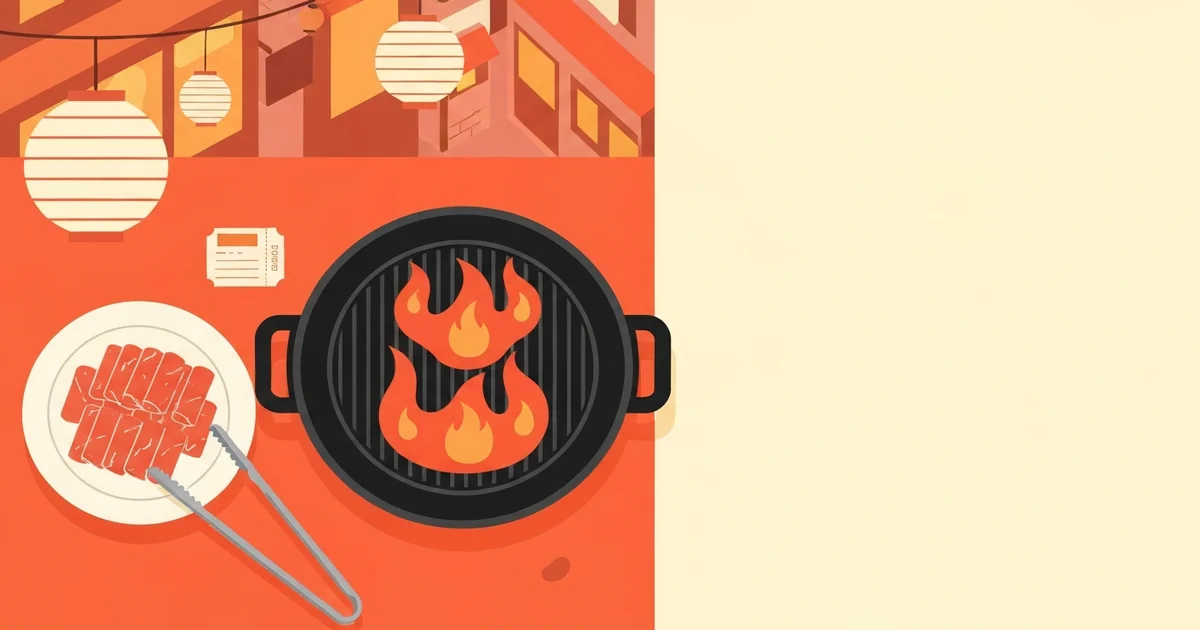
Walk into a 불판 restaurant in Hongdae on a Saturday evening and someone at the grill will probably say 불 올려도 될까요, asking if they can turn up the flame. It's not a phrase any textbook front-loads, but it's completely real Korean. What makes it interesting is what's underneath it: Korean has two separate roots for fire, one native and one borrowed from Chinese characters, and knowing the difference changes what you can read on a menu, a safety sign, and an emergency exit all at once.
불 (Bul) and 화 (Hwa): fire has two roots in Korean
Korean vocabulary operates in two registers. Native Korean words, called 고유어 (goyueo), tend toward the short and physical: sounds, sensations, things you can point at directly. Sino-Korean words, called 한자어 (hanjayeo), come from Chinese characters and dominate formal, compound, and official vocabulary. Fire has one root in each register. 불 (bul) is the native Korean word. It's what a child says when pointing at a birthday candle, what a server announces before lighting a charcoal grill, and what you shout in a genuine emergency. One syllable. Immediate. 화 (hwa) is the Sino-Korean reading of 火, the Chinese character for fire. It rarely stands alone. Instead it compounds into official vocabulary: fire disasters, geological formations, military terms. 화재 (hwajae) is a fire incident; 화산 (hwasan) is a volcano, literally a fire mountain; 방화 (banghwa) is arson. If you see 화 in a two-syllable word on a sign, you're almost certainly in formal territory. Fire has pronunciation audio for both roots, which helps once you realize they sound quite different: 불 is low and blunt, 화 is open and breathy.
Everyday phrases built around 불
불 compounds naturally in native Korean. That means it shows up in words you'll encounter before you're anywhere near an intermediate level. 불이야! (buriya) is the emergency shout. The -이야 suffix signals urgency and immediacy, marking it as a declaration rather than a neutral statement. You won't need it often (hopefully), but you'll hear it in K-drama fire scenes, and recognizing it in context matters. 불꽃 (bulkkot) combines 불 with 꽃, the word for flower. Fire-flower. Koreans use it for a spark, a flame, and a firework. In July and August, the Han River hosts 불꽃축제 (bulkkot chukjae), fire-flower festivals drawing crowds from across Seoul. Lightning is a natural companion here since 번개 (beongae, lightning) and 불꽃 come up together during summer storms and outdoor celebrations. 촛불 (chosbul) puts 촛 (candle) before 불. Candlelight. In 2016 and 2017, Gwanghwamun Square in Seoul became the site of one of the largest candlelight protest gatherings in Korean history, remembered as the 촛불집회 (chosbul jiphoe). 불 sits at the center of that compound, and knowing it there changes what the word feels like. 불씨 (bulssi) means a spark or ember. 씨 (ssi) is the word for seed. Fire-seed: the tiny thing that starts or sustains a larger flame. It also carries a metaphorical sense in Korean, much as 'spark' does in English.
At the Korean grill table
A significant slice of Korean food vocabulary includes 불 for a direct reason. The cooking method, open flame applied to meat at the table, simply named itself into the dishes. 불고기 (bulgogi) means fire meat. 불 plus 고기 (meat). In practice it refers to thinly sliced, marinated beef cooked over a grill or stovetop pan. It's one of the first Korean words most learners pick up because it appears on restaurant menus worldwide. Bulgogi covers the pronunciation and how to order it correctly in a Korean restaurant. 불판 (bulpan) is the grill plate placed over the heat source at the center of the table. 판 means a flat surface or board. You'll use it if you need to ask for a plate replacement: 불판 교체해주세요 (please replace the grill plate). 불닭 (buldak) means fire chicken, and it's also the name behind the internationally recognizable 불닭볶음면 instant noodles. The 불 here is intentional and accurate. These are genuinely, aggressively spicy products. Spicy is the companion piece for the heat vocabulary around these dishes, since 맵다 (maepda), the native Korean word for spicy, comes up constantly alongside 불 at any Korean table where someone orders the fire chicken. Noticing 불 in food names starts to feel like a pattern pretty quickly. It tells you something about the cooking method and the heat level before you've tasted anything.
화재 and when the formal fire vocabulary matters
화 (hwa) belongs to a different register entirely. You won't use it at a restaurant, but you'll encounter it in places where clarity and formality are required. 화재 (hwajae) is the standard official word for a fire incident. 재 (jae) means disaster or accident. 화재경보 (hwajae gyeongbo) is a fire alarm; 화재 신고 (hwajae singo) is a fire report. Seoul's fire safety signage uses 화재 consistently. The building instructions say 화재 발생시 (in case of fire). Recognizing it on a placard means you're not guessing at the emergency instructions. 소화기 (sohwagi) is a fire extinguisher. 소 (so) here means to extinguish, 화 is fire, 기 (gi) is a device or instrument. It's the red cylinder mounted on walls in Korean public buildings, subway stations, and apartment corridors. Reading the character and knowing it links to 화 makes it memorable rather than a random string of syllables. Emergency room has the broader emergency vocabulary you'd want alongside this, including how to use 119, South Korea's combined fire and ambulance emergency number. 화력 (hwaryeok) means firepower or heating power. You'll see it on electric kettle labels and oven settings, where it describes heat output rather than anything military. Same root, different compound.
Fire vocabulary at a glance
- 불 (bul): fire, native Korean, the everyday word for flames, heat, and the concept in most daily speech
- 화 (hwa): the Sino-Korean fire root, appears in formal compound words rather than standing alone
- 불이야! (buriya): Fire! The emergency shout, urgency marked by the -이야 suffix
- 불꽃 (bulkkot): flame, spark, or firework, literally fire-flower in Korean
- 불씨 (bulssi): ember or spark, literally fire-seed
- 촛불 (chosbul): candlelight, combining the candle and fire characters
- 불고기 (bulgogi): marinated grilled beef, literally fire meat
- 불판 (bulpan): grill plate used at Korean barbecue tables
- 불닭 (buldak): fire chicken, the name behind the internationally sold spicy fried chicken and noodle brand
- 화재 (hwajae): fire incident or fire emergency, the official formal term
- 소화기 (sohwagi): fire extinguisher
- 화산 (hwasan): volcano, literally fire mountain
Common questions
Q: What's the difference between 불 and 화재 when talking about fire in Korean?
불 (bul) is the native Korean word used in everyday speech: talking about a grill flame, a candlelight, a campfire, or any direct sensory reference to fire. 화재 (hwajae) is the Sino-Korean compound used for official or emergency contexts: fire incidents, building safety notices, insurance documents. The distinction mirrors how English uses 'fire' casually but 'fire incident' or 'combustion event' in formal writing. If you're at a restaurant and the server asks about the grill heat, 불 is the word in play. If you're reading the emergency evacuation instructions on the back of a hotel door, you'll see 화재. For pronunciation of both, Fire has audio for each variant so you can hear the difference clearly.
Q: How do you call for help in a fire emergency in Korea?
불이야! (buriya) is the shout for a fire you can see, designed to alert people around you immediately. For calling the fire department and emergency services, dial 119: South Korea's unified emergency number for fire, ambulance, and rescue. When you call, saying 불이 났어요 (buri nasseoyo), meaning 'a fire broke out,' communicates the situation clearly and quickly. You can follow with your location. Seoul and other major Korean cities have English-speaking operators available at 119, but knowing the Korean phrase helps in the seconds before you're connected. Help has the core vocabulary for emergency situations more broadly.
Q: Why do so many Korean food names include 불?
Korean grilling culture runs through the country's food identity in a way that goes beyond technique. Sitting at a table in Mapo or Gangnam and cooking your own meat over a live flame at the center of the table isn't just a method: it's the defining feature of the dish and the social experience around it. So the fire gets named directly into the food. 불고기 (fire meat), 불닭 (fire chicken), 불판 (fire plate): each name tells you exactly what kind of heat is involved before you sit down. It's functional naming that doubles as an invitation. Spicy helps with the adjacent vocabulary, since dishes carrying 불 in their name tend to run hot in more ways than one.
Keep the fire going with Koko
불 is one of those Korean roots that starts appearing everywhere once you know it: restaurant name boards, safety signs on subway platforms, song titles, product packaging. That's the payoff for learning at the level of the building block rather than the surface phrase. You don't just know 불고기, you recognize the 불 inside it and start connecting it to 불꽃 and 촛불 and 소화기 almost automatically. Koko AI gives you conversation practice that moves vocabulary like this from something you recognize to something you'd actually reach for. Start a session there when you're ready to use 불이야 in a sentence instead of just reading it.
