
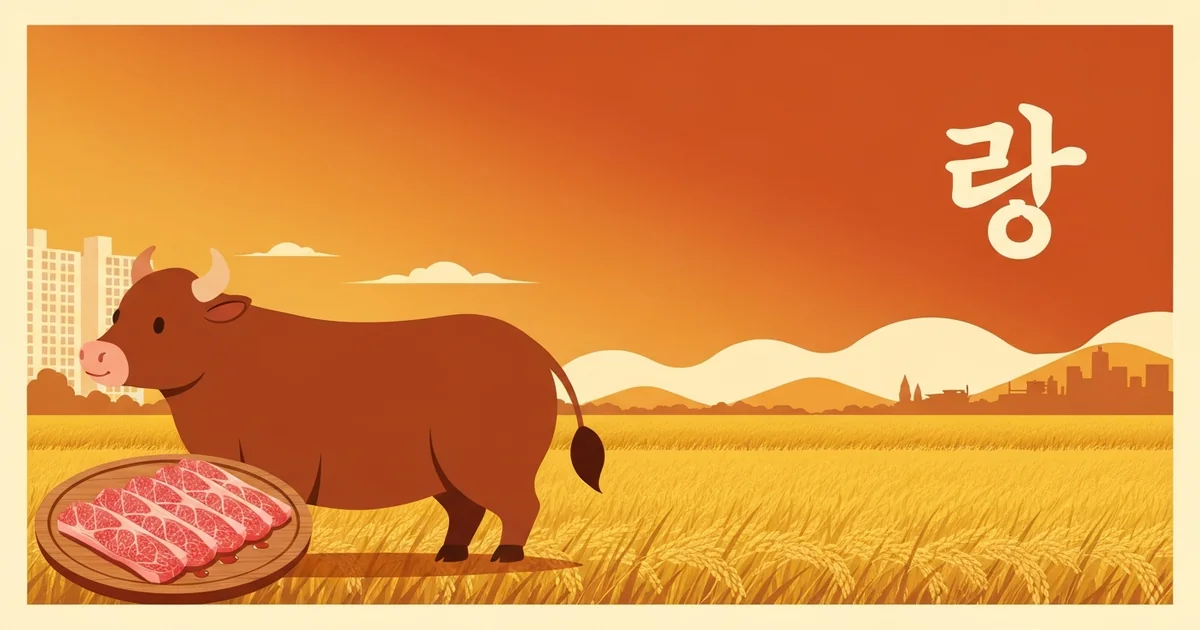
At any Korean barbecue restaurant in Hongdae, the menu runs in three columns: 소고기, 돼지고기, 닭. Beef, pork, chicken. If you've ever pointed at the wrong column by accident, you know exactly why learning 소 matters early. 소 (so) is the Korean word for cow or cattle, and it reaches far beyond the menu: into the zodiac, into proverbs about stubbornness, and into the vocabulary for one of Korea's most celebrated food traditions.
소, the word you'll hear at every Korean barbecue table
소 (so) is one syllable. Pronounce it like the English 'so' in 'so long,' and every Korean listener will understand you. The vowel is clean and open, not the muddied 'oh' that sometimes sneaks into English pronunciation attempts. When you need more precision, 소 builds into compounds naturally. 황소 (hwangso) is a bull or ox. 암소 (amso) is specifically the female cow. 송아지 (songaji) is a calf. In daily life, most of these stay in the background: you'll say 소 when talking about the animal generically, and the more specific forms show up in agricultural, literary, or idiomatic contexts. Cow has the syllable-by-syllable breakdown if you want to nail the vowel quality before your next vocabulary session. Korean doesn't pluralize nouns the way English does, so 소 covers one animal and an entire herd depending on context. One 소. A hundred 소. The sentence around the word handles the rest. For the sound a cow makes: English has 'moo,' Korean has 음매 (um-mae). This matters more than it sounds. Korean animal onomatopoeia follows its own phonetics, and knowing 음매 lets you decode children's books, animations, and the occasional joke built entirely around what a cow says.
쇠고기 and the world of Korean beef
소고기 and 쇠고기 both mean beef, and both descend from 소. The 쇠 form is older and appears more often on traditional menus and formal writing. The 소고기 form is the everyday supermarket and spoken version. Neither is wrong. Use 쇠고기 if you're writing a recipe; use 소고기 if you're talking to a market vendor. Koreans won't correct you either way. Korean beef culture has developed around 한우 (Hanu), the native Korean cattle breed raised since the Joseon period for its distinctive fat marbling and flavor. Today it's graded by the Korean government on a scale from 1++ down to 3, and premium 한우 restaurants in Gangnam serve single cuts the way a fine steakhouse in Tokyo presents wagyu. It's not cheap. But the Delicious vocabulary earns its place when you're eating 1++ 한우 갈비off a charcoal grill. For the cuts vocabulary, Beef covers 갈비 (ribs), 등심 (sirloin), 차돌박이 (brisket), and the others you'll see at any Korean barbecue table. Korean barbecue pairs that vocabulary directly with the Meat culture of grilling together at the table, clipping the beef with scissors as it cooks. It's genuinely different from restaurant meat-eating in most parts of the world, and knowing the word for each cut changes the experience. Knowing 소고기 also helps you distinguish it cleanly from Pig (돼지고기, pork) and Chicken (닭고기, chicken). Those three words cover the majority of meat-based Korean menus. Learn all three together and the menu becomes readable almost immediately.
Year of the Ox: zodiac, folklore, and 황소고집
The Korean zodiac (띠, tti) runs on a 12-year cycle. 소 is the second animal, arriving after the rat and before the tiger. People born in 1961, 1973, 1985, 1997, 2009, and 2021 are all 소띠 (sotti), born in the Year of the Ox. In 2021, Korean calendar makers sold out early. Cow plushies filled convenience store displays. Bakeries sold rice cakes shaped like calves. If you've got a Korean friend who told you they're 소띠, you now know exactly what they meant. In Korean cultural shorthand, 소띠 people are described as diligent, patient, and steady. Whether or not you take zodiac personality typing seriously, the language around it comes up constantly in Korean small talk. Asking 무슨 띠예요? ('what's your zodiac animal?') is a normal way to orient yourself in a conversation about age, which matters in Korean social dynamics more than most outsiders expect. The idiom 황소고집 (hwangso gojip) combines 황소 (bull, ox) with 고집 (stubbornness, a refusal to budge). Together they describe the particularly immovable kind of pigheadedness. Koreans use it affectionately and critically depending on tone. If your Korean teacher says 황소고집이 있어요 about a student who keeps repeating the same grammar mistake, it's a mild rebuke. If your friend says it about themselves while laughing, it's self-aware humor. The cultural depth behind 소 in Korean folklore runs older still. Before mechanized farming arrived across rural Korea in the 1970s, oxen plowed paddy fields from Jeju to the northern plains. They were a farming family's most valuable asset, sometimes housed indoors during winter to protect them from cold. Chuseok captures that agricultural heritage in its autumn harvest context, where the connection between land, livestock, and community still shows up in the rituals observed today.
Animal vocabulary that clusters around 소
Korean animal vocabulary clusters logically. Learn 소 and you understand 소고기. Learn 돼지 and you get 돼지고기. Learn 닭 and you get 닭고기. The pattern is consistent: animal name plus 고기 (meat) equals the food term. It makes the vocabulary more learnable than it looks on a list. The animal words you'll want nearby as you build vocabulary around 소:
- 소 (so): cow, cattle (general)
- 황소 (hwangso): bull, ox
- 암소 (amso): female cow
- 송아지 (songaji): calf
- 돼지 (dwaeji): pig. See Pig
- 닭 (dak): chicken. See Chicken
- 말 (mal): horse
- 양 (yang): sheep or goat
A note worth keeping: 말 (horse) uses the same romanized syllable as 말 (speech, language, word) in Korean. Two completely different characters collide at the same pronunciation. Korean teachers enjoy the joke that 말을 배우다 can mean 'to learn a horse' or 'to learn language.' Context saves you every time, but it's one of those learner moments worth expecting rather than being surprised by.
Common questions
Q: What's the difference between 소고기 and 쇠고기?
Both mean beef, and both are correct. 쇠고기 is the older, more formal form that appears on traditional restaurant menus and in written Korean recipes. 소고기 is the everyday spoken and supermarket-shelf version. Native Korean speakers use both interchangeably depending on region, age, and context. In Seoul you'll mostly see 쇠고기 on premium 한우 menus and 소고기 on casual signage. Don't overthink the distinction: say 소고기 in conversation and no one will blink. For the cuts vocabulary that goes with it, Beef breaks down 갈비, 등심, and the others you'll see at any barbecue table worth sitting at.
Q: How do I bring up 소띠 in a Korean conversation?
Zodiac talk is normal small talk in Korea, especially between people trying to figure out relative ages without asking directly. You can ask 무슨 띠예요? ('what's your zodiac animal?') in almost any casual social setting. If someone says 소띠예요, they were born in one of the Year of the Ox years: 1961, 1973, 1985, 1997, 2009, or 2021. A natural follow-up is 그럼 참을성이 강하겠네요, meaning 'you must have a lot of patience.' It's a light compliment and usually lands well. If you're 소띠 yourself, saying 저는 소띠예요 with a small smile is all you need to open the topic.
Q: How important is 소 vocabulary for a Korean learner?
It depends on what you're doing in Korean. If you eat Korean food, travel to Korea, or watch K-dramas with any regularity, you'll encounter 소고기, 한우, and 소띠 quickly. The zodiac vocabulary opens a whole category of casual conversation that Koreans use to decode social situations. The beef vocabulary makes every restaurant visit easier and less stressful. The idiom 황소고집 gives you a vivid way to describe someone who absolutely will not back down from a position. None of this is advanced Korean. It's foundational vocabulary that compounds into other useful words faster than you'd expect.
소 connects to more than you'd expect
소 is a learner-friendly word precisely because it doesn't stay isolated. It pulls you toward beef vocabulary, zodiac conversation, agricultural history, and a handful of idioms that make Korean writing feel more textured once you know them. The Koko AI app organizes Korean words by the contexts where you'd actually encounter them, which means 소 shows up near 소고기, 한우, and 소띠 rather than in an alphabetical list between unrelated terms. Start with the cow. The language builds from there, one syllable at a time.
