
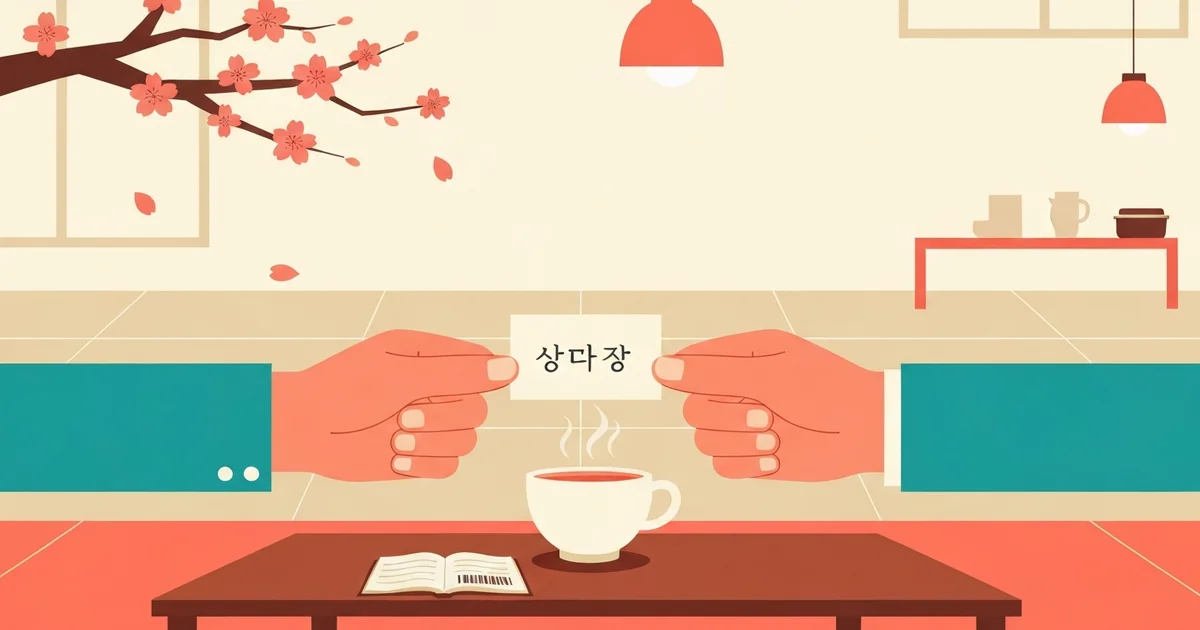
Something happens in the few seconds before a Korean says 만나서 반갑습니다. There's a quick calculation. Age, job title, the context of the introduction: all of it feeds into decisions about bow angle, speech level, and what word the other person will use to address you for the rest of your relationship. English collapses this entire moment into one phrase. Korean unpacks it into a small, well-practiced social ritual. The phrase itself isn't hard. The system around it takes longer to learn.
만나서 반갑습니다: the phrase unpacked
The standard polite greeting is 만나서 반갑습니다 (mannaseo bangapseumnida). Parse it out: 만나서 comes from the verb 만나다, to meet. 반갑습니다 comes from 반갑다, an adjective meaning to feel glad or happy. Together: 'having met you, I am glad.' The emotion follows the meeting rather than leading it, which feels distinctly Korean.
Two softer versions sit alongside it. 만나서 반가워요 drops the register slightly and works for introductions between peers or people close in age. The casual form, 만나서 반가워, lands between same-age acquaintances or close friends. Which version you reach for tells the other person a lot about how you've read the situation.
One more phrase belongs in your first-meeting toolkit: 처음 뵙겠습니다 (cheoeum boepgetseumnida). This one sits a register higher than 만나서 반갑습니다. You'd hear it at job interviews in Gangnam, at formal business dinners, or when meeting someone significantly senior to you. 뵙다 is the honorific form of the verb 'to see or meet,' so the phrase signals an extra layer of respect that 반갑습니다 doesn't carry. In everyday situations, 만나서 반갑습니다 is perfectly fine. At a job interview or when addressing someone with a formal title, reach for 처음 뵙겠습니다.
Age comes first, and that's not nosy
Among the things that surprise learners about Korean introductions, this one tops the list: Koreans often ask each other's age within the first minute of meeting. Not as small talk. As infrastructure.
Korean grammar has two main speech registers: 존댓말 (formal and polite speech) and 반말 (informal speech). You can't choose the right one until you know your relative position to the other person. Age and hierarchy are baked directly into the language itself. Being one year older than someone changes the verb endings, the tone particles, and the address terms that flow between you. A quick 나이가 어떻게 되세요? (How old are you, in the polite form) resolves the ambiguity. It's logistics, not nosiness.
I've watched this play out at Korean university orientations, company dinners, and casual coworker lunches. Two people meet, exchange names, and within thirty seconds the age question surfaces. Once it's answered, everything else calibrates fast. Speech levels lock in. Address terms settle. The relationship knows where it stands, and conversation can actually begin.
Bowing: three angles, three different signals
The bow accompanying 만나서 반갑습니다 isn't decorative. It's information. Three main angles, three distinct messages.
A small nod of roughly 15 degrees acknowledges a peer at a casual introduction or a quick passing greeting on a busy corridor. A 30-degree bow is the workhorse: the angle you'd use meeting a new colleague, a client in a Seoul business district, or your Korean language tutor for the first time. A 45-degree bow or deeper signals genuine respect, reserved for elders, high-status figures, or anyone you'd also address as 선생님 (seonsaengnim) rather than a first name.
Eye contact matters too. During the bow, eyes go down. Coming back up, you meet the other person's gaze briefly. Maintaining eye contact throughout a deep bow reads as defiant rather than respectful. Koreans clock the angle and gaze combination in about one second. Get both right and you've communicated something before you've said a word.
What you'll be called after the introduction
After the first 만나서 반갑습니다, first names don't always follow. Korean has a detailed address system built around relationship and age.
Same-age peers become 친구 (chingu). That word is precise: it means someone born in the same year as you, not 'friend' in the broad English sense. If you're even a year older, different terms apply: 형 (hyung, used by males toward older males), 오빠 (oppa, used by females toward older males), 언니 (unnie, used by females toward older females), 누나 (noona, used by males toward older females). In professional settings, titles take over. Doctors, lawyers, teachers, and other respected professionals get the honorific suffix 님 attached, and 선생님 expands well beyond 'teacher' to cover anyone you'd address with formal professional respect.
It sounds complicated listed out like that. In practice, Koreans navigate it instinctively. Your job is to learn the framework. Once you do, you'll notice it running in the background of every Korean conversation you observe or join, quietly organizing every exchange.
First meetings in K-drama: two scenes worth watching
K-dramas stage Korean introductions constantly, and two series are especially useful for learners watching how the ritual actually works.
In Extraordinary Attorney Woo (이상한 변호사 우영우), the 2022 ENA series that became one of the most-watched Korean shows on Netflix that year, lead character Woo Young-woo introduces herself with a palindrome observation every time she meets someone new: 똑바로 읽어도 거꾸로 읽어도 우영우. Read it forward or backward, it's still 'Woo Young-woo.' Her introduction is unconventional, but it works against the well-known Korean introduction script: state your name, offer a relevant detail, close warmly. The show is worth watching to see how her non-standard approach plays against characters who know exactly what the standard script expects.
Reply 1988 (응답하라 1988), the 2015 tvN series set in Seoul's Ssangmun-dong neighborhood, shows introductions embedded in daily neighborhood life rather than formal first-meeting settings. Neighbors introduce themselves through shared meals and chance hallway crossings. Watch how adults address each other and how the age-based hierarchy holds itself up through tiny, repeated exchanges. The series is a working model of Korean social structure, wrapped in a nostalgic coming-of-age story.
Vocabulary for your first Korean meeting
- 만나서 반갑습니다 (mannaseo bangapseumnida): nice to meet you, standard polite form. Full entry and audio.
- 처음 뵙겠습니다 (cheoeum boepgetseumnida): formal 'nice to meet you,' used at job interviews and with seniors.
- 안녕하세요 (annyeonghaseyo): hello, the all-purpose greeting that usually comes before 만나서 반갑습니다 in a formal sequence.
- 잘 부탁드립니다 (jal butakdeurimnida): literally 'please take care of me,' said after introductions to open the relationship warmly.
- 나이가 어떻게 되세요? (naiga eotteoke doeseyo?): how old are you? Polite form, used to calibrate speech levels.
- 존댓말 (jondaetmal): formal and polite speech, the register used with strangers, elders, and superiors.
- 친구 (chingu): friend, specifically a same-year peer. Not interchangeable with the English 'friend.'
- 감사합니다 (gamsahamnida): thank you, commonly said at the close of a formal introduction.
Common questions
Q: Is asking someone's age when you first meet them considered rude in Korea?
In Korean culture, asking 나이가 어떻게 되세요? isn't rude. It's practical. The Korean language has two speech registers that work differently depending on relative age, so knowing the answer resolves a real linguistic problem. Most Koreans understand that the question surprises non-native speakers, and they'll often explain the reason if you look confused. If you'd rather not give a precise age, you can name the decade you're in: 삼십대예요 means 'I'm in my thirties.' That's enough for the other person to calibrate speech levels without needing an exact number. See Age and hierarchy for more on why this question runs so deep in Korean social interaction.
Q: What's the difference between 만나서 반갑습니다 and 처음 뵙겠습니다?
Both mean 'nice to meet you,' but 처음 뵙겠습니다 sits a register higher. The verb inside it, 뵙다, is the honorific form of 'to see or meet.' Using 처음 뵙겠습니다 signals that you recognize the other person as your senior or superior. It's appropriate at job interviews, formal business dinners, and when meeting anyone you'd address with a professional title. In everyday first meetings with peers or people close in age, 만나서 반갑습니다 is the better fit. Switching between the two isn't hard once you've learned to read the context.
Q: How do you introduce yourself in Korean?
The standard Korean self-introduction follows a short, reliable structure: start with 안녕하세요, then state your name with 저는 [name]입니다 (I am [name]), and close with 만나서 반갑습니다. In professional settings, add your role: 저는 디자이너입니다 (I'm a designer). Many Koreans finish a formal self-introduction with 잘 부탁드립니다, which translates roughly as 'please take good care of me' and functions as a warm, open-ended invitation into the relationship. Learn that phrase alongside thank you, and your Korean first impression will land the way you want it to.
Practice the ritual, not just the phrase
Korean first meetings pack more into thirty seconds than most learners expect. 만나서 반갑습니다 opens the door, but the bow angle, the age question, the register choice, and the address terms waiting on the other side are where real fluency starts. Koko AI is a free Korean speaking tutor built on voice conversation. You can practice full introductions in context, from a casual peer meeting at a Hongdae cafe to a formal job interview in Gangnam, and get instant feedback on whether your speech level, pronunciation, and phrasing are landing. Practice the whole ritual, not just the phrase.
