
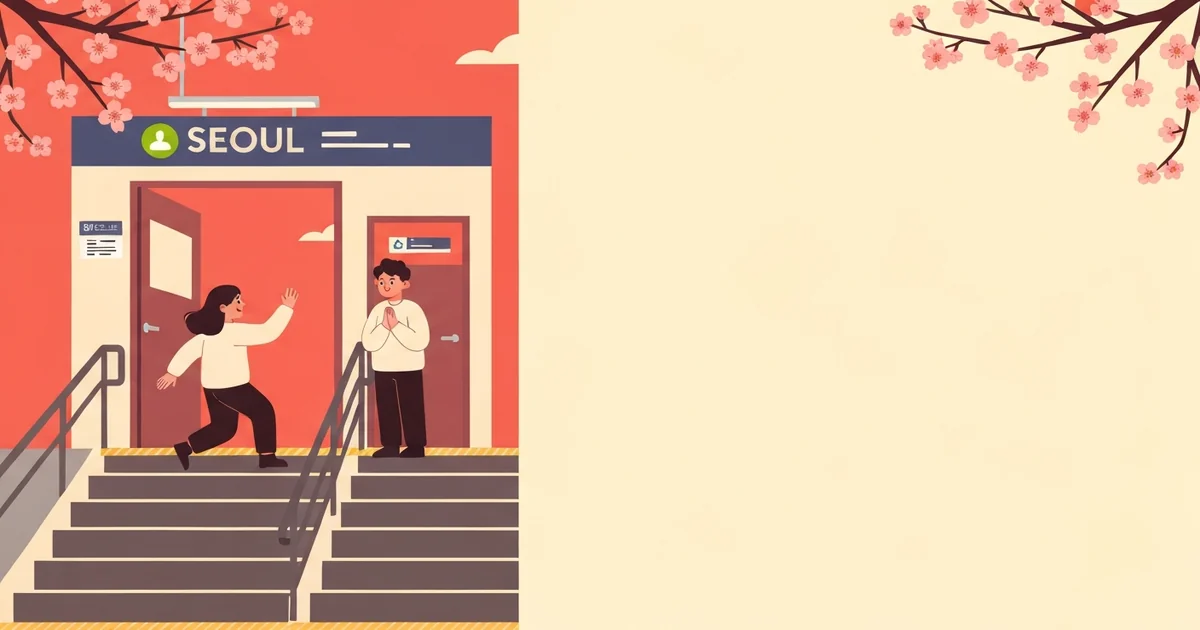
조심해 (josimhae) and 조심하세요 (josimhaseyo) are both Korean for 'be careful,' one informal and one formal. You'll use the casual form with close friends and family, and the polite version almost everywhere else. What surprises many learners is that 조심하세요 regularly closes conversations as a farewell. It isn't only a caution. In Korea, telling someone to be careful as they leave is simply how you show you care about them.
Two words, one caution
The verb at the center of both phrases is 조심하다 (josimhada). 조심 (josim) carries the idea of attentiveness, of watching your step. 하다 (hada) is the standard verb 'to do.' Together: to exercise caution, to be mindful of your surroundings. Stack a different ending onto 조심 and the register shifts. 조심해 (josimhae) is the plain form, casual register. Say it with close friends, siblings, or anyone younger than you. It's direct, warm, and entirely appropriate between people who are comfortable together. 조심하세요 (josimhaseyo) uses the polite-formal ending. Use it with coworkers, teachers, seniors, strangers, or anyone you'd naturally address with 존댓말 (jondaemal), the formal speech register that reshapes every Korean verb ending. Honorific speech explains how that formality system works across the whole language, not just with caution phrases. There's a middle register too: 조심해요 (josimhaeyo). The -요 (yo) suffix softens informal speech into something polite without going fully formal. You'll hear this between acquaintances and colleagues of similar age. Korean has at least three politeness lanes, and 조심 travels fluently in all of them. When in doubt, 조심하세요 is the safe default. It reads as respectful without sounding stiff.
When 조심하세요 becomes a farewell
This is the part most Korean textbooks skip. In everyday speech, Koreans use 조심하세요 as a parting phrase the way English speakers use 'take care' or 'be safe.' Imagine stepping out of a café in Myeongdong after a long lunch. As you head toward the subway, the person you were with might call after you: 조심해서 가세요 (josimhaeseo gaseyo), which asks you literally to 'go carefully.' Or a shorter 조심하세요 alone. It doesn't mean something bad is about to happen. It means: I noticed you're leaving, and I want you to get home in one piece. The fuller form, 조심해서 가세요, packs real warmth into four syllables without being dramatic. Goodbye (when you leave) has the pronunciation for the leaving-side farewell; Goodbye (when you stay) covers the version said by the person staying behind. When someone uses 조심하세요 as a farewell, the natural response is 네, 조심할게요 (ne, josimhalgeyo), meaning 'yes, I'll be careful.' Or simply mirror it back: 조심하세요 to them. This habit of care-shaped goodbyes runs through Korean vocabulary more broadly. 잘 자요 (sleep well), 밥 잘 먹어요 (eat properly, a caring wish for the other person's nourishment), 잘 도착해요 (arrive safely): Korean farewells frequently take the form of small wishes for physical wellbeing. Take care and Stay safe are sibling phrases to 조심하세요, worth learning as a set because they come up in the same goodbye situations.
The full vocabulary of caution
Once you have the core phrase down, a few related forms give you more range:
- 조심스럽다 (josimseureopda): to be cautious, delicate, or careful in handling something. Often describes a person's manner, as in 그 사람은 조심스러워요 (that person is careful or gentle).
- 조심성 (josimseong): carefulness as a character trait. 조심성이 있어요 means 'they're a careful person,' said as a compliment.
- 조심해서 (josimhaeseo): 'carefully' as an adverb. You'll hear 조심해서 운전하세요 (drive carefully) at gas stations and in directions all over Seoul.
- 주의하다 (juyihada): a slightly more formal synonym meaning to pay attention or be watchful. Leans toward instructions and public warnings rather than personal care.
- 주의하세요 (juyihaseyo): 'please be careful' or 'caution.' You'll see this on signage in Seoul's subway stations, printed on yellow warning strips at escalator edges.
The pair 조심 and 주의 often overlap. But the feel is different. 조심 reads as personal and relational; 주의 leans toward instructions and public notices. Think of the difference between a friend warning you about icy pavement and a sign that says 'Caution: Wet Floor.' The emotional texture is completely different even when the caution itself is the same. For pronunciation at natural speed, Be careful walks through both 조심해 and 조심하세요 with audio.
Hearing it in K-drama
응답하라 1988 (Reply 1988, 2015), set in the real Ssangmun-dong neighborhood of Seoul, is one of the best Korean dramas for hearing authentic everyday speech. The characters speak the way ordinary people actually talked in mid-1980s Seoul, including the exact moments when someone shifts from 조심해 with a close friend to 조심하세요 with a neighbor or elder. It's never explained out loud. You just watch it happen. That register shift becomes intuitive through repeated exposure. Farewell phrases cluster through every neighborhood departure scene. Characters rarely leave without some form of 잘 가세요 or 조심해서 가세요 trailing behind them. For the pronunciation and grammar of the formal farewell pair, Goodbye covers 안녕히 가세요 and 안녕히 계세요 together. A more recent example: in Extraordinary Attorney Woo (이상한 변호사 우영우, ENA 2022), the protagonist's father sends her off to work each morning with small rituals of care. 조심해서 가세요 at the door isn't a big moment. It's just there, episode after episode, because that's what Korean families do. When someone in your life speaks Korean and you want to match that warmth: use 조심해서 가세요 when they're heading out at night. If they've been sick recently, pair it with Get well soon. If they're anxious about something coming up, Don't worry rounds out the vocabulary of care.
Common questions
Q: What's the difference between 조심해 and 조심하세요?
Both mean 'be careful,' but the ending changes the register. 조심해 (josimhae) is informal and works with close friends, younger family members, or people you're already comfortable with. 조심하세요 (josimhaseyo) is polite-formal and fits almost any other context: with coworkers, teachers, seniors, or strangers. There's also 조심해요 (josimhaeyo), a middle option with the -요 softening particle. When in doubt, 조심하세요 is the safe choice. It reads as respectful without sounding overly formal. Learning Korean's full politeness system helps here: Honorific speech explains how register shifts work across all Korean verb endings, not just this phrase.
Q: Is it strange to say 조심하세요 as a goodbye?
Not at all. 조심하세요 as a farewell is completely normal in Korean, especially in the fuller form 조심해서 가세요 ('go carefully'). English speakers sometimes find it unusual because 'be careful' in English mainly signals that danger is coming. Korean uses it differently. It's a gentle expression of care for the other person's journey. You'll hear it most often when someone leaves at night, when they're about to drive, or when they've been unwell. The expected response is 네, 조심할게요 ('yes, I'll be careful') or just a reciprocal 조심하세요 back.
Q: How do Koreans say 'I arrived safely'?
잘 도착했어요 (jal dochak-haesseoyo) or 무사히 도착했어요 (musahi dochak-haesseoyo), meaning 'I arrived well' or 'I arrived safely.' Koreans often send this as a text message to let the person who saw them off know they got home. It's the natural follow-up to 조심해서 가세요: after someone sends you off with 'go carefully,' you close the loop later with 'I arrived safely.' I arrived safely has the full phrase with audio. Once you know this habit exists, you'll start noticing how many Korean conversations have this two-part structure, a send-off phrase and a safe-arrival message that closes it.
Practice until it feels instinct
The gap between knowing 조심하세요 and reaching for it naturally is mostly repetition. 조심해 clicks fast because it's short and phonetically simple: three syllables, all clear. 조심하세요 takes a bit longer (five syllables, jo-sim-ha-se-yo), but it comes up in daily Korean life often enough that you'll have plenty of real chances. Koko AI builds those practice opportunities into conversation context, so phrases like this stop living in a vocabulary list and start feeling like something you'd actually say at the end of a conversation.
