
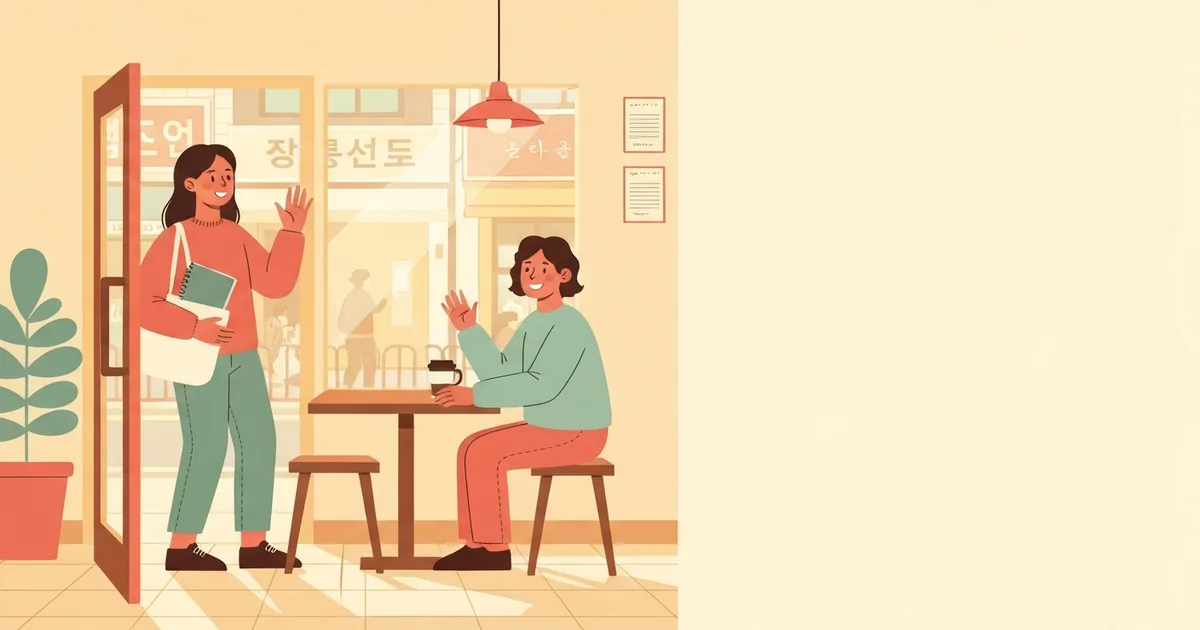
In English, 'have a good day' ends almost every transaction. Cashiers say it. Dentists say it. Your barista says it while handing over your cup. Korean has equivalent warmth in parting, but 좋은 하루 되세요 (joeun haru doeseyo) sits in a different social spot. You'd use it with a colleague leaving the office after a long morning, or at the close of a professional phone call. The phrase carries real intention. It's not a reflex.
Breaking down 좋은 하루 되세요, word by word
Three parts make the meaning. 좋은 (joeun) is the adjective form of 좋다, the base verb 'to be good,' modifying whatever comes after it. 하루 (haru) means 'one day' or simply 'a day.' The third piece, 되세요 (doeseyo), is the polite form of 되다, a verb that translates as 'to become.' When you say 좋은 하루 되세요, you're not telling someone to have a good day in a transitive sense. You're wishing that the day itself transforms. The literal reading is: may this day become a good one for you. That's a subtly different offer than 'have fun today,' and it shows up in the extra warmth the phrase carries when you mean it. The Have a good day entry covers the full pronunciation, including the 되 vowel cluster that consistently catches learners who expect a single clean sound. If you're working on time vocabulary at the same time, Day explains the difference between 하루 and 날, two words that both appear as 'day' in English but function differently in Korean sentences.
되세요 or 보내세요? Choosing the right verb
The other common form is 좋은 하루 보내세요 (joeun haru bonaeseyo). You'll hear both phrases in Seoul offices and on professional phone calls, and both translate as 'have a good day.' The verb makes the difference. 보내다 (bonada) means 'to send' or 'to spend time.' 좋은 하루 보내세요 asks someone to spend a good day, rather than for the day to become good. The emphasis shifts from the day itself to what the person does with it. Neither is wrong. In practice, 되세요 reads as slightly more formal and set-phrase-like, the kind of closer you'd use at the end of a business call. 보내세요 sounds a shade more active. Both are natural in professional Korean conversation. When you're face-to-face and heading out of a Gangnam office after a meeting, either phrase lands well. Goodbye covers the broader farewell vocabulary, while Goodbye (when you leave) gives you the specific phrase that the person who is physically departing uses.
From formal to casual: the full register range
Korean's politeness system shapes this phrase at every level. The -세요 ending on 되세요 and 보내세요 marks the formal-polite tier: safe to use with seniors, clients, professors, and anyone you'd use full honorifics with. For a semi-formal register, -세요 steps down to -요. 좋은 하루 보내요 (joeun haru bonaeyo) keeps the baseline politeness marker without the full honorific weight. This works with same-age coworkers, newer acquaintances, or anyone in the middle range of your social circle. With close friends or people younger than you, the endings drop entirely. 좋은 하루 보내 (joeun haru bonae) is the casual version. It's the text-message equivalent of 'have a good one.' The sentiment is identical; the register is lighter. For quick in-person goodbyes that often precede or follow this phrase, See you later covers 다음에 봐요 and similar expressions you'll hear at the end of casual meetups around Hongdae or Itaewon.
When Koreans actually reach for this phrase
Phrasebooks list 좋은 하루 되세요 without telling you where it fits. Here's what's useful to know. The phrase isn't reflexive in Korean the way 'have a good day' is in English service culture. A clerk at a Hongdae convenience store finishing your transaction won't typically say it. That silence isn't unfriendliness. Korean service scripts for short commercial exchanges don't include it as a default send-off, and most Koreans wouldn't expect it there either. You'll hear 좋은 하루 되세요 at the end of business phone calls, especially longer ones. After work meetings when someone is heading out. In professional chat messages wrapping up a longer exchange. Korean customer service emails often close with it as a standard sign-off phrase. I find it useful to teach this alongside a cultural note. The drama 응답하라 1988 (Reply 1988), set in the real Ssangmun-dong neighborhood of Seoul, shows characters parting with short, direct phrases: 잘 가 (jal ga, go safely) and 조심해 (josimhae, be careful). The longer, more polished 좋은 하루 되세요 pattern grew more common in Korean professional culture through the 1990s and 2000s as office norms formalized. For your broader vocabulary set, Good morning pairs naturally with 좋은 하루 되세요 as the two poles of a Korean workday: the phrase that opens the morning and the one that closes the afternoon.
A parting phrase vocabulary list
These phrases aren't interchangeable, but they are combinable. Once you understand the base structure, 좋은 + [time period] + 되세요 or 보내세요, you can build variations for weekends, evenings, and longer spans. Below is the vocabulary you'll reach for most often.
- 좋은 하루 되세요 (joeun haru doeseyo): formal 'have a good day,' the day becomes good
- 좋은 하루 보내세요 (joeun haru bonaeseyo): formal 'have a good day,' spend a good day
- 좋은 하루 보내요 (joeun haru bonaeyo): semi-formal parting wish, same warmth
- 좋은 하루 보내 (joeun haru bonae): casual 'have a good one,' for close friends and peers
- 즐거운 하루 되세요 (jeulgeoun haru doeseyo): 'have a pleasant day,' slightly warmer register
- 좋은 주말 보내세요 (joeun jumal bonaeseyo): 'have a good weekend,' formal
- 잘 지내세요 (jal jinaeseyo): 'take care' or 'be well,' a broader wellbeing wish
- 잘 가세요 (jal gaseyo): 'go safely,' used when someone is physically departing
- 수고하세요 (sugohaseyo): 'keep up the good work' or 'take care,' common in workplaces
Common questions
Q: Is 좋은 하루 되세요 natural, or does it sound too formal for everyday use?
It's natural in the right context. In professional settings like phone calls, meeting sendoffs, or customer service emails, 좋은 하루 되세요 sounds exactly right. In casual settings with close friends, it can carry slightly formal weight (the way 'have a splendid afternoon' might in English), so 좋은 하루 보내 works better there. If you're unsure about the register, both 보내세요 and 되세요 are safe choices that won't read as awkward. Take care covers 잘 지내세요, a softer all-purpose alternative that crosses more social contexts.
Q: How do I say 'have a great weekend' in Korean?
좋은 주말 보내세요 (joeun jumal bonaeseyo). The structure is identical to 좋은 하루 보내세요: swap 하루 (haru, one day) for 주말 (jumal, weekend) and the phrase is ready. For a warmer version, 즐거운 주말 보내세요 (jeulgeoun jumal bonaeseyo) means 'have an enjoyable weekend.' These are among the most common Friday sendoffs in Seoul offices. The casual forms follow the same pattern: 좋은 주말 보내요 for semi-formal contexts and 좋은 주말 보내 among close friends. Once you have the base structure, you don't need to memorize each variation separately.
Q: What's the difference between 좋은 하루 되세요 and 잘 가세요?
잘 가세요 (jal gaseyo) is specifically about the physical act of leaving. It means 'go safely' or 'go well' and applies when someone is literally departing: leaving the building, heading to the subway, getting in a car. 좋은 하루 되세요 wishes well for the rest of the person's entire day, not just the journey home. In many Korean farewells, you'll hear both: 잘 가세요 at the door as a send-off, 좋은 하루 되세요 as the wider wish for the afternoon ahead. Goodbye (when you stay) covers 안녕히 계세요, the phrase used by the person who stays behind as someone else leaves.
The phrase that closes a Korean workday
Korean farewells are more layered than a single 'bye.' You track who's leaving, the formality of the relationship, and whether you're wishing someone safe passage on a journey or sending them off into the rest of their afternoon. 좋은 하루 되세요 handles that last intent cleanly. Koko AI is built around Korean as it actually lives in conversation: the phrase from a client call, the parting at a Seoul office door, the text to a friend on a Friday. Practice 좋은 하루 되세요 alongside 10,000+ other Korean words and phrases. Free on iOS and Android.
