
When late June arrives in Seoul, umbrella displays move to the front of every convenience store in Hongdae. No announcement. Koreans just know 장마 is coming. Rain in Korean starts with one syllable, 비 (bi), but the vocabulary built around it touches food, friendships, and the specific texture of a Korean summer.
비 (bi): where every rainy forecast starts
비 (bi) is the building block. You'll find it in Weather forecast apps, in texts sent to cancel outdoor plans, and in the phrase beginners pick up first: 비가 와요 (bi-ga wayo), it's raining. The verb here is 오다 (oda, to come). Korean rain doesn't fall. It arrives. That small choice shapes the whole phrase: 비 is treated as something on its way toward you, not something already happening overhead.
The tense forms follow the same logic: 비가 왔어요 (bi-ga wasseoyo) means the rain came, 비가 올 것 같아요 (bi-ga ol geot gatayo) means it looks like rain will come, and each conjugation preserves that sense of 비 as an approaching presence rather than a fixed atmospheric condition. You can find the full pronunciation and conjugation breakdown at Rain.
장마 and the rains that reshape June
장마 (jangma) is Korea's monsoon season. It settles over the peninsula from mid-June to mid-July, and it doesn't behave like a passing shower. This isn't an afternoon cloud that drifts through and clears by evening. 장마 runs for weeks, sometimes with only brief dry windows between heavy bands of cloud. Seoul changes during this stretch: outdoor café chairs disappear, Han River footpaths close when water levels rise, and convenience stores near Gangnam Station start stacking single-use rain ponchos by the register.
Reply 1988, tvN's 2015 series set in Seoul's real Ssangmun-dong neighborhood, captures this rhythm accurately. Summer rain there isn't a dramatic event. Characters open their gates, pull hoods up, and keep walking. That unsentimental response is true to life. Koreans who grew up with 장마 don't treat it as a disruption. It's the weather of the season, and the season comes every year.
Alongside 장마, Korean has a second important word for rain: 소나기 (sonagi), a sudden shower. Where 장마 is scheduled and relentless, 소나기 ambushes you on a clear afternoon, soaking you before you've had time to realize it's actually raining and not just warm summer mist. The two words exist because the two experiences are genuinely different. If you've ever been caught in a 소나기 without an Umbrella, you already understand the distinction better than any definition can.
Pajeon, makgeolli, and the rainy day ritual
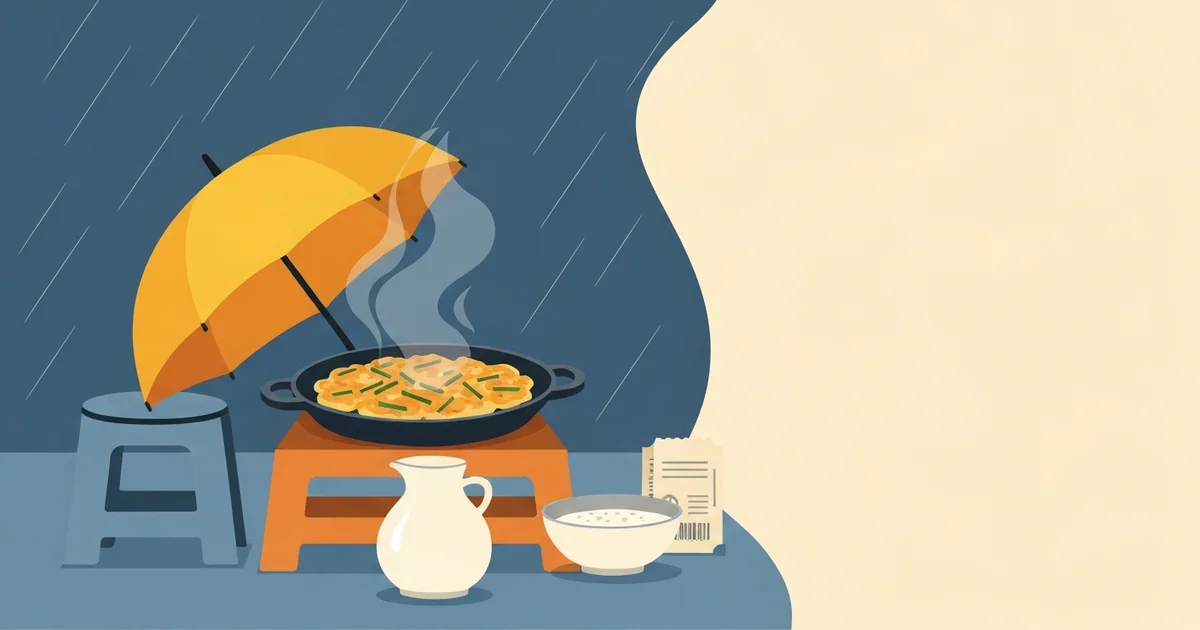
There's a sensory logic to Korea's most famous rainy day ritual that most Koreans can't fully explain, because it became automatic a long time ago. 파전 (pajeon) is a savory pancake made with scallions, batter, and often seafood. When it hits the oiled pan, it produces a sizzle Koreans write as 지글지글 (jigeuljigeul). That sound, Koreans say, is close to 추적추적 (chujeokchueok), the soft onomatopoeia for a steady rain. The sonic similarity is thought to be the origin of the pairing. Korean pancake is the word to know before visiting any market in the rain.
The drink alongside it is Rice wine, a milky rice wine with a slightly sweet, slightly earthy flavor and low enough alcohol that a glass or two feels right on a slow afternoon. The pairing is so established that makgeolli sales in Seoul tend to climb noticeably ahead of 장마 season every year. It's one of those culturally embedded behaviors that doesn't need a trend to sustain it. The rain comes. The pajeon pan goes on. The makgeolli gets cold.
A vocabulary for every kind of rain
Korean gives you 비 as the foundation and then layers more specific words on top. Once you know these, the Weather conversation opens up considerably.
- 비 (bi): rain, the core word. See Rain.
- 비가 오다 (bi-ga oda): to rain, literally 'rain comes.' The verb form you'll use every day.
- 소나기 (sonagi): a sudden shower, brief and intense. No warning, no gradual build.
- 가랑비 (garangbi): drizzle, light gentle rain. See Drizzle.
- 장대비 (jangdaebi): heavy downpour, literally 'pole rain.' The kind that bends umbrellas.
- 장마 (jangma): monsoon rainy season, mid-June through mid-July. See Rainy Season.
- 비바람 (bibaram): rainstorm with wind, combining 비 (rain) and 바람 (wind).
- 우산 (usan): umbrella. Umbrella.
- 비가 그쳤어요 (bi-ga geuchyeosseoyo): the rain has stopped. The sentence you'll want after a long 장마 morning.
Common questions
Q: How do you say 'it's raining' in Korean?
The phrase is 비가 와요 (bi-ga wayo) in polite speech, or 비가 와 (bi-ga wa) with close friends. 비 is rain, 가 is a subject particle, and 와요 is the polite present form of 오다 (to come). The literal meaning is 'rain is coming,' not 'rain is falling,' which is part of why Korean weather conversation sounds subtly different when translated into English. If you want to ask before stepping outside, 비가 와? (bi-ga wa?) becomes a question in casual speech. You can also say 비가 오고 있어요 (bi-ga ogo isseoyo) for an ongoing present tense: rain is coming right now. The full conjugation set is at Rain.
Q: When is rainy season in Korea?
Korea's rainy season, 장마 (jangma), runs roughly from mid-June to mid-July, though the exact timing varies by year and region. The southern parts of Korea, including Jeju Island, Busan, and the coastal provinces, typically receive heavier rainfall than Seoul and the northern regions. 장마 isn't like other rain. It's persistent, sometimes running for three weeks with only short dry breaks in between. If you're planning a trip to Korea in summer, June is generally overcast and wet. July can swing between lingering 장마 and sudden intense heat. You can explore the seasonal context further at Rainy Season and Monsoon season.
Q: Why do Koreans eat pajeon when it rains?
The short answer is sound. The sizzle of pajeon batter on a hot pan, 지글지글 (jigeuljigeul), is phonetically close to 추적추적 (chujeokchueok), the Korean onomatopoeia for the soft patter of falling rain. The sonic similarity is the most cited explanation for how the pairing took hold, though the association is now so deeply embedded in Korean culture that most people don't consciously think about why. It's simply what you eat when it rains, especially during 장마 season. The classic pairing is Korean pancake with Rice wine. If you're ever in Korea when the sky opens up, finding a spot that serves both takes about thirty seconds of walking from any Seoul side street.
Practice before the next 장마
Korean rain vocabulary is a practical entry point into the language. It comes up in daily conversation, in Weather apps, and in K-drama scenes where characters run for shelter or settle into a pojangmacha while the rain comes down outside. Once you know 비, 장마, 소나기, and 비가 와요, you've got a working vocabulary for most rainy-day Korean. Koko AI is a free Korean speaking tutor that you can use to practice all of it out loud, hear native pronunciation for words like 가랑비 and 비바람, and build the reflexes you need before the next forecast crosses your screen. One syllable at a time, one season ahead.
